
Blooming
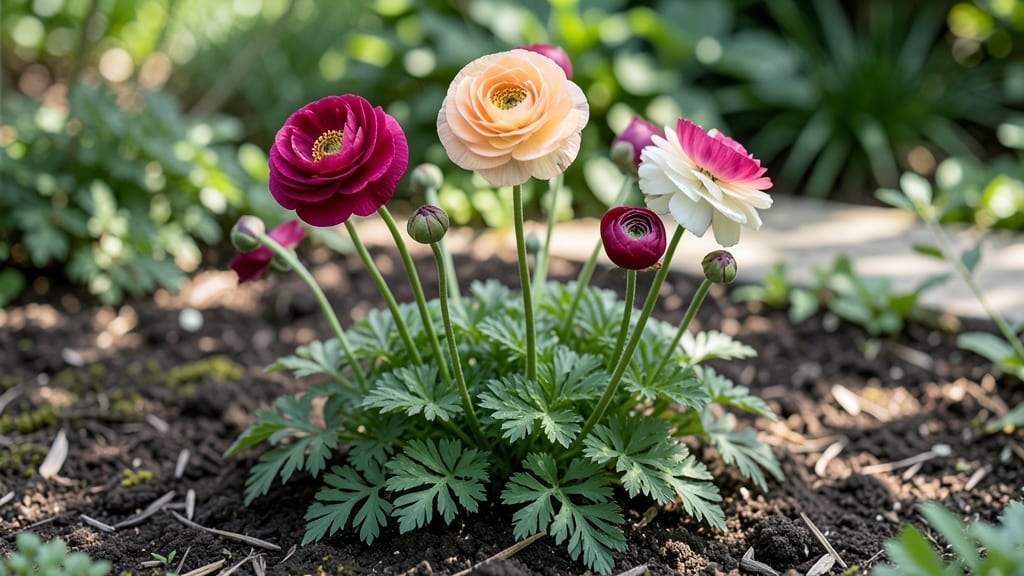
Ranunculus don't bloom all summer—they prefer cool spring and fall conditions, typically flowering for just 4-6 weeks before heat stress forces them into dormancy or leaf damage. With the right care, you can sometimes coax a few extra weeks of blooms.
These delicate perennials are actually cool-season plants, meaning they perform best when temperatures stay between 50-75°F.
When summer heat hits 85°F or higher, their petals start to wilt, and foliage may turn yellow or crisp at the edges. 🌸 The good news is that with afternoon shade and consistent moisture, you can sometimes stretch their blooming period into early summer or late summer before the heat becomes too intense.
Think of them like seasonal performers—they put on their best show when conditions are ideal, then take a break when it gets too hot. Many gardeners actually replant ranunculus in late summer for a stunning fall display, since they'll often rebloom when temperatures drop again.
💡 In This Article
- Temperature and Light Requirements for Ranunculus Blooms
- Extending Ranunculus Season: Shade and Watering Hacks
Temperature and light requirements for ranunculus blooms
Ranunculus flowers are native to Mediterranean and mountainous regions where they experience hot, dry summers and cool, moist winters. This evolutionary history explains why they thrive best in 50-75°F temperatures—their ideal range for photosynthesis and bloom production.
When daytime temperatures climb above 85°F, their metabolic processes slow dramatically, causing petals to droop and leaves to develop brown, crispy edges from dehydration. The key mechanism here is how heat disrupts their cellular water balance, forcing them into a survival mode that prioritizes leaf protection over flower production.
The light requirements add another layer of complexity. While ranunculus need 6-8 hours of sunlight daily for optimal flowering, direct afternoon sun during summer months becomes problematic. The high-intensity rays at 12-4 PM (when UV index often exceeds 7) can cause photodamage to their delicate petals, accelerating the wilting process.
What's fascinating is how their foliage actually acts as a heat shield—broader leaves reflect some sunlight, but when temperatures exceed 90°F, even this protection fails, leading to rapid leaf scorch. This is why you'll often see gardeners use 30-50% shade cloth during peak summer heat.
Here's what happens at the cellular level: Heat stress triggers a cascade of reactions where ranunculus produce more ethylene gas—a plant hormone that accelerates aging. You'll notice buds that would normally open over 5-7 days in cool weather instead wither within 24 hours when exposed to prolonged heat.
The good news is that this process is reversible when temperatures drop—many gardeners report seeing new buds form within 10-14 days after a heatwave breaks, as the plants "reset" their metabolic priorities.
Light quality matters just as much as quantity. Ranunculus prefer the blue spectrum (400-500nm wavelength) found in morning sunlight, which promotes strong stem development. Afternoon light shifts toward the red spectrum (600-700nm), which while great for photosynthesis, becomes harmful when combined with high temperatures.
This is why partial shade solutions work so well—they filter out the most damaging wavelengths while still allowing beneficial light penetration. A simple test is to observe how your plants respond: if new leaves develop a reddish tint rather than their normal green, that's a sign of heat stress.
Consider this comparison: In spring conditions (55-65°F), ranunculus can produce 50-100 flowers per stem over 4-6 weeks. Under summer heat (above 85°F), that number drops to 10-20 flowers with significantly shorter vase life.
The difference comes down to how heat affects their sugar metabolism—they simply can't produce enough energy to support abundant blooming when temperatures rise. This is why professional florists often grow ranunculus in cooled greenhouses during summer months, maintaining temperatures between 65-72°F to extend their marketable lifespan.
The most critical window is between 10 AM and 4 PM—this is when you'll see the most dramatic effects of heat stress. During these hours, even well-watered plants may show signs of wilting because their roots can't absorb moisture fast enough to compensate for evaporative loss.
The solution lies in understanding this daily rhythm: providing afternoon shade while maintaining morning sun exposure gives you the best chance of prolonging their blooming period by 2-4 weeks during summer months. 🌿