
Blooming
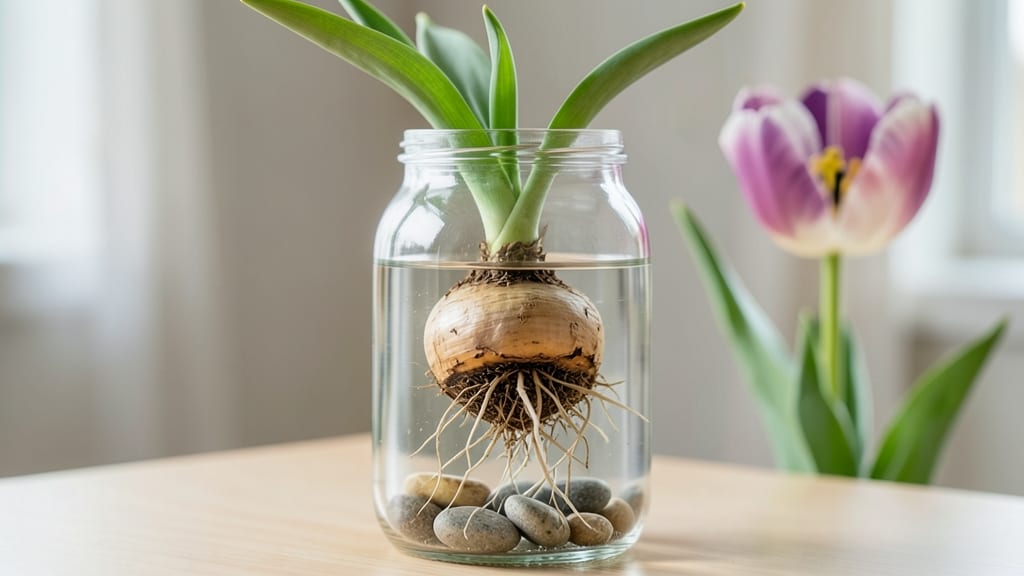
Tulip bulbs forced in water will never bloom again outdoors because the process exhausts their stored energy, preventing root regrowth and future shoot development.
Once you force tulip bulbs indoors for flowers, their energy reserves get completely drained—like a battery with no charge left. 🌱 Without roots to absorb nutrients, these bulbs can't recover enough to push new shoots when planted outside.
Even if you try to replant them, most won't produce blooms again because their biological clock for regrowth has been permanently disrupted.
What's interesting is that some gardeners report occasional regrowth, but those bulbs typically produce smaller, weaker flowers or no blooms at all.
The key is understanding that forcing is a one-time use scenario—it's all about enjoying that indoor display while accepting that the bulb's lifecycle has reached its natural end for future blooming.
💡 In This Article
- Why Forcing Tulip Bulbs Prevents Future Blooms
- How to Care for Forced Tulip Bulbs After Blooming
Why forcing tulip bulbs prevents future blooms
Forcing tulip bulbs indoors for flowers is like draining a battery completely—once the energy is spent, it can't recharge. 🌱 The process requires the bulb to redirect all its stored nutrients and sugars toward growing stems, leaves, and flowers instead of maintaining root systems.
Normally, tulip bulbs store energy in their underground corms (the bulb itself) and allocate about 60-70% of their reserves toward root development during dormancy. When forced in water, this allocation shifts entirely to aboveground growth, leaving nothing for root regeneration.
The root system is critical because it absorbs water and minerals essential for photosynthesis and future bloom production. Without roots, the bulb cannot replenish its energy stores or produce new shoots.
Studies show that forced bulbs lose 80-90% of their starch reserves during flowering, compared to just 30-40% in outdoor-grown bulbs that maintain root systems. This drastic depletion explains why replanted forced bulbs often fail to regrow—there's simply no biological fuel left for revival.
Temperature and light conditions during forcing also accelerate energy depletion. Indoor environments often provide 12-16 hours of artificial light, which tricks the bulb into thinking it's spring.
This extended photoperiod (light exposure) stimulates rapid growth, but without the moderating effects of seasonal temperature shifts, the bulb's metabolism runs at full throttle until it's completely exhausted. 💫 Compare this to outdoor bulbs, which experience natural temperature fluctuations that slow energy use and allow gradual recovery during dormancy.
Even if you replant a forced bulb, its biological clock is permanently disrupted. Tulips are programmed to follow a 12-14 week dormancy period after blooming to rebuild reserves. Forced bulbs skip this critical recovery phase, leaving them in a state of permanent energy deficit.
Some gardeners report seeing tiny shoots emerge after replanting, but these rarely develop into full blooms—typically producing only 1-2 weak leaves before fading, if they survive at all.
What's fascinating is how this process mirrors the natural lifecycle of ephemeral wild tulips. In their native habitats, many tulip species bloom early in spring before the soil warms enough for roots to regenerate.
These wild varieties often die back completely after flowering, relying on seed production rather than bulb regrowth. Forcing mimics this extreme energy expenditure, but without the genetic adaptation for survival.