
Blooming
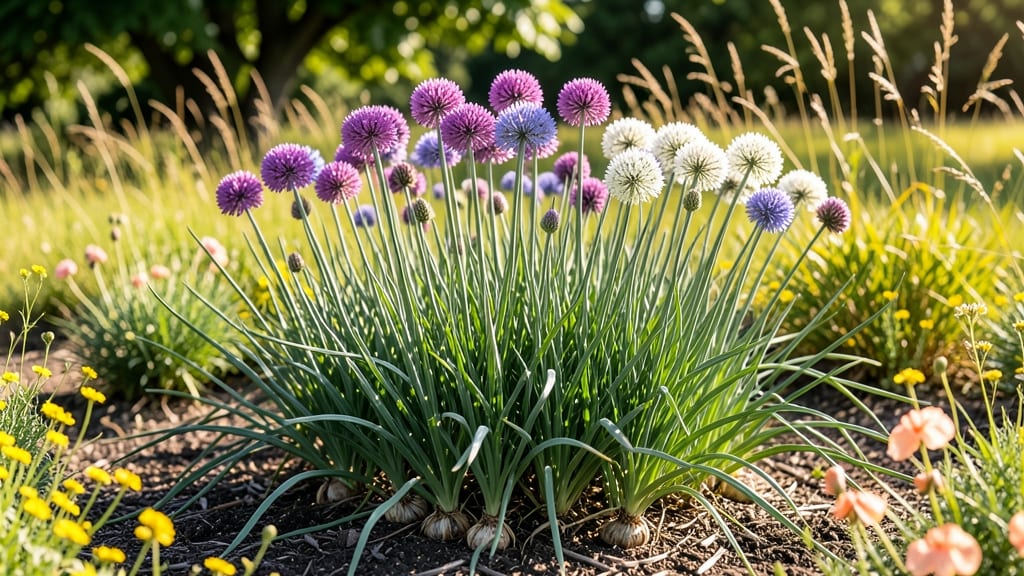
Alliums don't bloom all summer—most varieties produce just one dramatic flower spike in late spring to early summer, though certain types like Allium schubertii or Allium giganteum may rebloom with full sun exposure and consistent care.
Most alliums follow a seasonal bloom pattern tied to their natural growing cycle, where they focus all their energy on one spectacular display rather than prolonged flowering. 🌸 The key difference lies in their growth habits—some species prioritize bulb development over repeated blooms, while others like globe alliums (Allium sphaerocephalon) may produce smaller secondary flowers later in the season if given proper nutrients.
Light intensity plays a huge role here: six or more hours of direct sunlight daily helps sustain energy reserves for potential reblooming, but even then, most alliums won't match summer annuals for continuous color.
What many gardeners discover is that alliums actually thrive on this single-bloom strategy—it creates dramatic focal points in spring gardens while their ornamental foliage remains attractive throughout the season.
The trade-off is intentional: instead of weak, scattered blooms, you get one stunning show that lasts 4-6 weeks, followed by months of architectural interest from their seed heads.
💡 In This Article
- Allium Bloom Cycles by Variety and Seasonal Factors
- Extending Allium Bloom Time with Proper Planting and Care
Allium bloom cycles by variety and seasonal factors
The blooming patterns of alliums are primarily governed by photoperiodism—the plant's response to daylight length. Most allium species, like the popular Allium giganteum or Allium 'Purple Sensation', trigger their single spring bloom when daylight extends beyond 12-14 hours in late winter.
This is their biological cue to shift energy from bulb storage to flower production, resulting in that one spectacular spike that can reach 3-5 feet tall and last 4-6 weeks. 🌿
Temperature also plays a critical role: alliums require 50-60°F soil temperatures to break dormancy and begin growth. Once blooming starts, they prefer 60-75°F days to sustain flower development.
The trade-off is intentional—most alliums prioritize bulb replenishment over repeated blooms, which is why you won't see continuous flowering like with petunias or zinnias.
Even Allium schubertii, known for potential reblooming, typically produces its main show in spring with smaller secondary blooms appearing only if given full sun (6+ hours daily) and consistent moisture.
Day-neutral alliums like Allium sphaerocephalon (drumstick allium) offer a slight exception—they may produce smaller secondary blooms in late summer if the plant has sufficient energy reserves. This happens because their flowering mechanism isn't as strictly tied to photoperiod as other varieties.
However, these secondary blooms are usually 20-30% smaller and less vibrant than the primary display. The key difference lies in their growth habit: while most alliums store energy in their bulbs for next year's bloom, these varieties allocate some resources to potential reblooming.
Light intensity directly impacts both bloom duration and potential for reblooming. Alliums grown in partial shade (3-5 hours of sun) will produce smaller, less vibrant flowers and are far less likely to rebloom.
The UV index matters too—higher light levels (above 5 on the UV scale) help maintain chlorophyll production, which sustains the plant's energy reserves. This is why alliums in coastal gardens or high-altitude locations often show more vigorous secondary blooming than those in shaded urban settings.
Consider the Allium 'Globemaster' as a case study: this variety typically blooms once in late spring with 2-inch-wide purple spheres containing hundreds of tiny flowers. Even under ideal conditions, it won't rebloom because its energy is primarily directed toward bulb expansion for next season's display.
The exception proves the rule with Allium 'Millenium', which may produce 10-15% smaller secondary blooms in late summer if given well-draining soil with pH 6.0-7.0 and 1 inch of water weekly during dry periods.
What most gardeners overlook is the allium's natural lifecycle strategy: instead of continuous blooming, they create dramatic focal points that last longer in the landscape. The 6-8 week bloom period is followed by 3-4 months of architectural interest from their papery seed heads, which many gardeners leave for winter interest.
This dual-purpose approach makes alliums more efficient energy-wise than annuals that must bloom continuously to set seed.