
Blooming
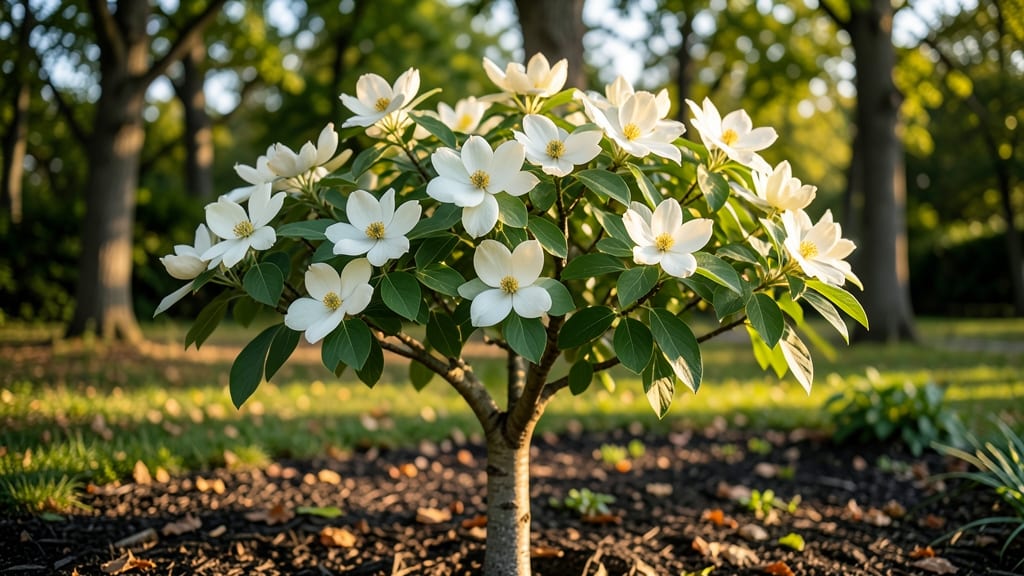
A dogwood bloom looks like a delicate four-petaled starburst, with white or pink bracts framing tiny greenish flowers at the center. These bracts appear to be petals but are actually modified leaves that create the showy display.
A dogwood's signature appearance comes from its bracts—those large, petal-like structures—while the actual flowers are the small greenish clusters hidden beneath. 🌸 This unique structure helps attract pollinators by creating a visually striking contrast.
Many people mistake these bracts for true petals, but they serve a different botanical purpose, acting as protective leaf-like structures that enhance the bloom's appeal.
What makes dogwood blooms particularly fascinating is how their appearance varies by species. For example, the Cornelian dogwood features bright red bracts in fall, while the Flowering dogwood showcases classic white or pink spring blooms.
The Pacific dogwood stands out with its larger, more dramatic bracts that can reach up to 4 inches across.
💡 In This Article
- Dogwood Bracts vs True Flowers: The Science Behind Their Appearance
- Identifying Dogwood Varieties by Bloom Characteristics
Dogwood bracts vs true flowers: the science behind their appearance
Dogwood blooms showcase one of nature's most clever botanical illusions. Those showy "petals" you see aren't true flowers at all—they're bracts, specialized leaves that have evolved to attract pollinators by mimicking petals.
These bracts are actually modified leaf structures that grow beneath the true flowers, creating a protective cup around them. This adaptation helps shield the delicate reproductive parts while making the bloom more visually striking to bees and other pollinators.
The true flowers themselves are tiny, greenish clusters hidden at the center, often just 0.25-0.5 inches wide. In contrast, the bracts can span 2-4 inches across, making them 8-16 times larger than the actual flowers. 🌿 This dramatic size difference creates the starburst appearance that makes dogwoods so recognizable.
For comparison, magnolia blooms have true petals that are all roughly the same size, while cherry blossoms feature uniform petal structures without this leafy framing.
This bract structure serves an evolutionary purpose beyond just looks. The leaf-like bracts contain chlorophyll, allowing them to photosynthesize while protecting the developing flowers. They also help regulate temperature and moisture around the true flowers, creating a microclimate that supports pollination.
In species like the Cornelian dogwood, these bracts even change color seasonally, turning bright red in fall to attract birds that help with seed dispersal.
What makes this adaptation particularly fascinating is how it differs from other spring bloomers. Unlike lilacs or forsythia, which rely solely on true petals for their visual impact, dogwoods use this two-tiered system where the bracts do most of the heavy lifting in terms of attracting attention.
The true flowers remain small and unobtrusive, focusing their energy on reproduction rather than showiness. This division of labor allows dogwoods to maintain their delicate appearance while still being highly effective at pollination.
When you examine a dogwood bloom closely, you'll notice the bracts often have subtle veins and textures that resemble leaves more than petals. Their edges may appear slightly serrated or lobed, particularly in species like the Pacific dogwood where the bracts develop a more pronounced leaf-like structure.
This botanical deception isn't just about looks—it's a sophisticated survival strategy that combines visual appeal with functional protection.
The contrast between bracts and true flowers becomes especially apparent when you see dogwoods in different stages of bloom. Early in the season, you might spot buds where only the bracts are visible, while later you can see the tiny green flowers peeking out from beneath.
This progression reveals the clever way nature has packaged these blooms to maximize their chances of successful pollination while maintaining their elegant appearance.